
Aviator is a crash game by Spribe in which a rising multiplier can stop when the round crashes. A payout is calculated from the stake and the multiplier at which the player’s cash-out request reaches the server.
The basic formula is simple, but settlement also depends on timing, the operator’s rules, and the result fixed for that round. This guide explains the calculation, confirmation process, verification method, and limits that can affect a win.
How Aviator Calculates Payouts
Aviator pays the stake multiplied by the cash-out multiplier when the cash-out request reaches the server before the crash. A player staking 10 at 2.00x has a calculated payout of 20 before any operator-specific rules are applied.
The multiplier is not a separate prize added to the stake. It is the factor applied to the original bet, so the profit is the payout minus the stake.
- Stake: the amount placed on the bet.
- Multiplier: the value shown when the cash-out request is made.
- Gross payout: stake multiplied by multiplier.
- Profit: gross payout minus the original stake.
For example, a 10 stake cashed out at 1.50x produces a 15 payout and a 5 profit. A 10 stake cashed out at 5.00x produces a 50 payout and a 40 profit.
| Stake | Cash-out multiplier | Calculated payout | Profit |
|---|---|---|---|
| 10 | 1.20x | 12 | 2 |
| 10 | 1.50x | 15 | 5 |
| 10 | 2.00x | 20 | 10 |
| 10 | 5.00x | 50 | 40 |
Aviator has two bet panels in each round. Each panel can have a separate stake and cash-out, allowing two calculations from the same round.
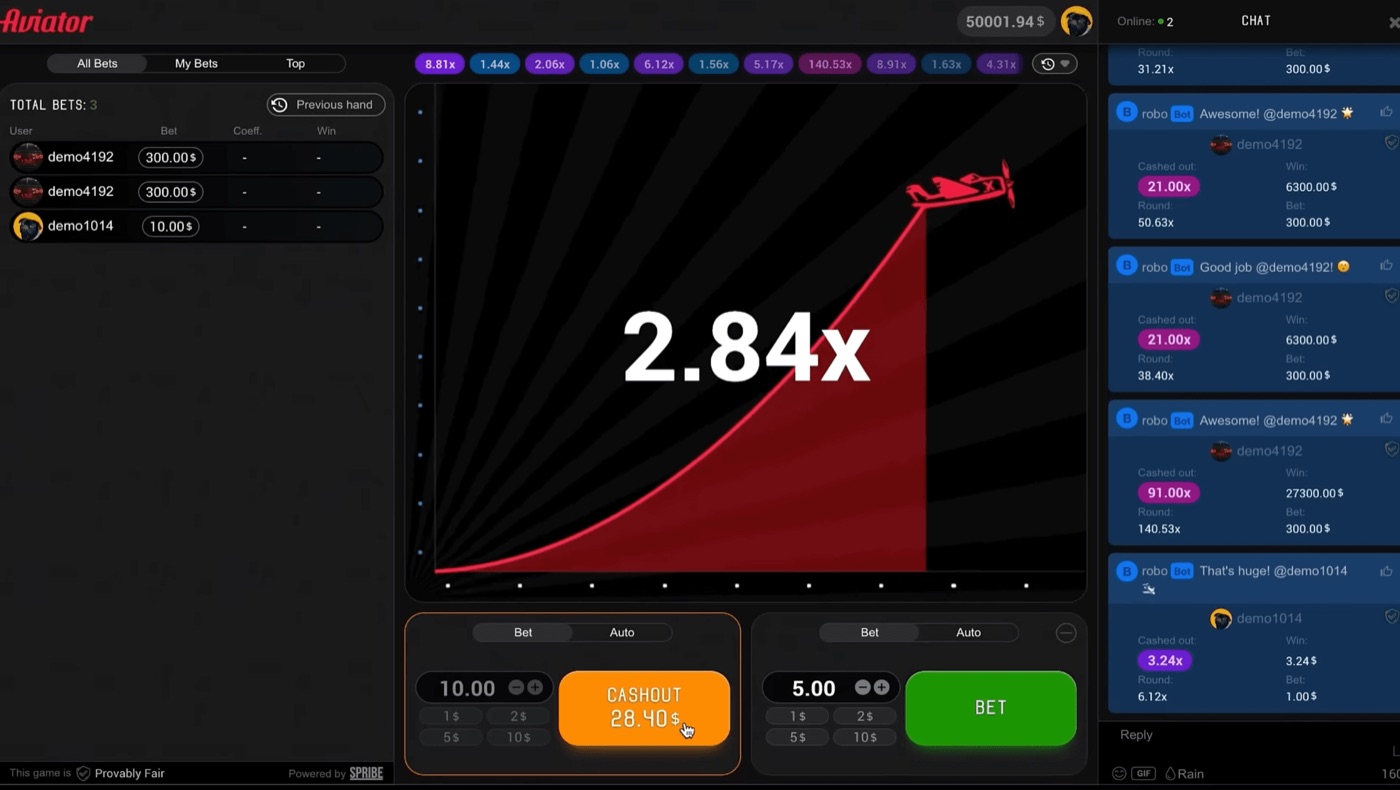
The interface shows live bets, chat, and a cash-out displayed at 28.40x.
Cash-Out Confirmation Timing
Aviator rounds last about 8 to 30 seconds, and the cash-out request must reach the server before the crash. A displayed multiplier does not by itself prove that the payout has settled.
The important event is the server receiving the request while the round is still active. If the request arrives after the crash, that bet does not settle at the earlier multiplier shown on the screen.
- Place a stake before or during the available betting stage.
- Watch the multiplier increase after take-off.
- Select cash-out or use an automatic cash-out setting.
- The server receives and processes the request.
- The settled value is based on the multiplier reached for that request.
Latency and a slow device can cause a cash-out time-out. This explains why the button can appear to be selected while the request still fails to reach the server before the crash.
Aviator includes an Auto Cash-Out setting. The player chooses a preset multiplier, and the system sends the cash-out request when that target is reached, but the request still has to reach the server before the crash.
- Manual cash-out uses the player’s input.
- Auto Cash-Out uses a preset multiplier.
- A time-out can result from latency or a slow device.
- The crash point cannot be changed after the round starts.
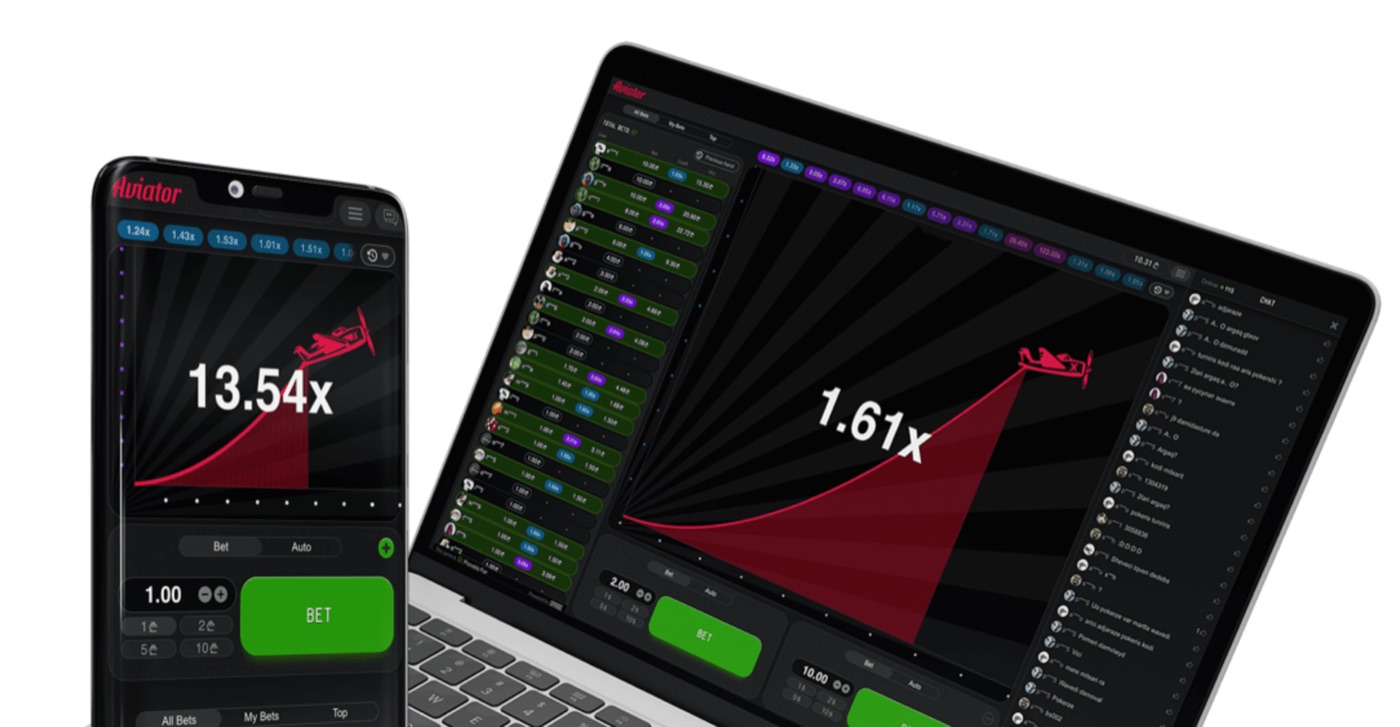
Aviator can run in a browser on a phone and laptop, with separate multiplier displays.
Round Results And Verification
Spribe fixes the Aviator crash point before take-off by using a server seed and player client seeds. The server publishes a SHA-256 hash of its server seed before each round.
After the round, the inputs are revealed and can be checked with the verification tool inside the game. This process lets the player compare the published hash with the revealed data.
The verification process matters to settlement because it identifies the fixed crash point for that round. Neither the operator nor Spribe can change the result after the round starts.
- The server publishes a SHA-256 hash before the round.
- Client seeds from players are combined with the server seed.
- The crash point is fixed before take-off.
- The inputs are revealed after the round.
- The in-game tool checks the result.
The Provably Fair badge provides access to this part of the game interface. It does not predict the next multiplier, because the verification process checks a completed round rather than forecasting a future one.
Aviator rounds are independent. Previous multipliers, a graph, a pattern, or a preferred time of play do not change the probability of the next round.
Multiplier Probabilities And RTP
Aviator has an RTP of 97% and a house edge of 3%. The probability that a round reaches multiplier m is 0.97 divided by m.
These figures describe the game over many rounds, not the result of one cash-out. The expected value is minus 3% of the stake at every cash-out target, while different choices change variance rather than the house edge.
| Target multiplier | Probability the round reaches it |
|---|---|
| 1.20x | 80.8% |
| 1.50x | 64.7% |
| 2.00x | 48.5% |
| 3.00x | 32.3% |
| 5.00x | 19.4% |
| 10.00x | 9.7% |
| 20.00x | 4.85% |
| 50.00x | 1.94% |
| 100.00x | 0.97% |
About 3% of rounds, or roughly 1 in 33, crash instantly at 1.00x. In that case, a player who has not completed a cash-out before the crash does not settle a winning payout for that bet.
Some guides discuss cashing out around 1.5x to 2x or splitting two bets between a lower target and a higher target. These choices can alter the pattern of wins and losses, but they do not remove the 3% house edge.
For a crash game, RTP is a long-run measure rather than a promise that a particular stake will return 97%. Players should set a spending limit and stop when it is reached.
In a gambling sentence about a crash game, a multiplier, and a cash-out, some players may encounter betway aviator live while comparing where an Aviator stake is placed; the settlement formula remains stake multiplied by the confirmed multiplier.
Operator Settlement Rules
Operator rules set the available stake range and the win cap for each round. Typical Aviator stakes range from about $0.10 to $100 per bet, but the exact amount depends on the operator.
Spribe has not published a maximum multiplier, and win caps per round are set by each operator. A high displayed multiplier therefore does not guarantee that the full calculated amount will be payable if an operator cap is lower.
- The minimum stake depends on the operator.
- The maximum stake depends on the operator.
- The maximum win per bet depends on the operator.
- The maximum win per round depends on the operator.
- Operator rules determine how a cap affects a large calculated payout.
The calculation still begins with stake multiplied by multiplier. The operator’s published cap can then restrict the amount settled for the bet or round, so players should check the rules before placing a large stake.
Two bet panels create another settlement detail. Each panel has its own stake and cash-out, so one panel can settle at a lower multiplier while the other remains open until a later cash-out or the crash.
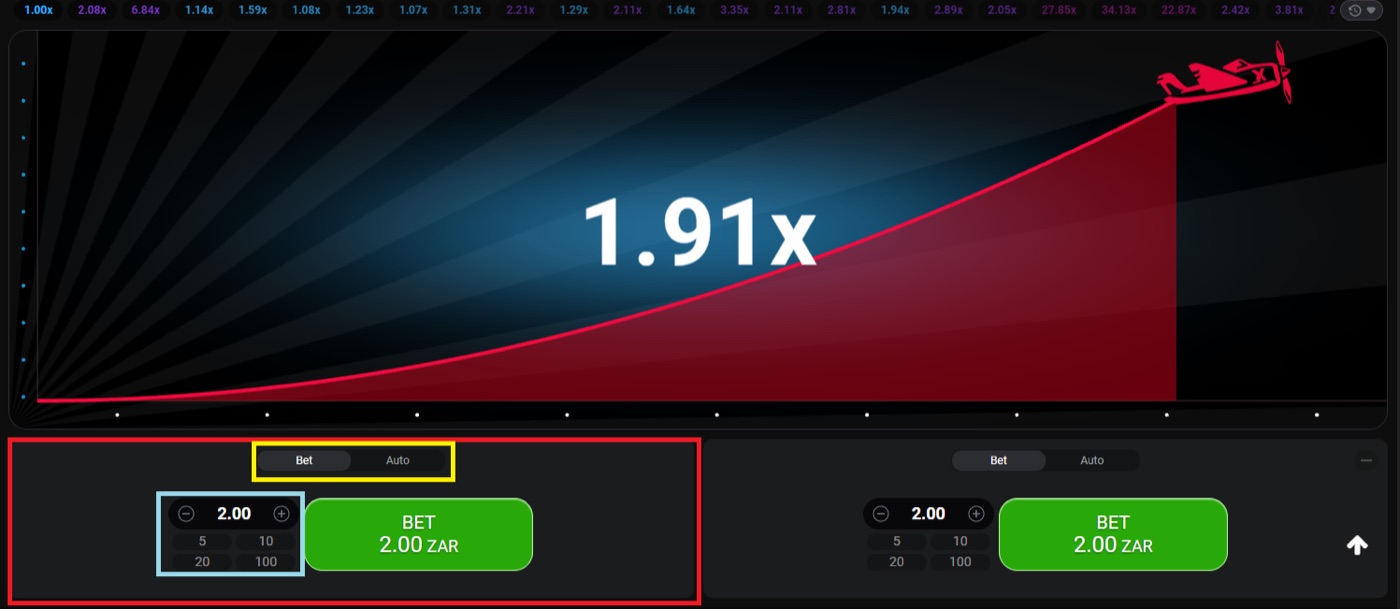
The desktop view shows a 1.91x round and two separate bet panels.
Auto Bet and Auto Play can be set for 10 to 100 rounds, with stop-on-win and stop-on-loss options. These features automate entries or stopping rules, but they do not change the operator’s caps, the RTP, or the 3% house edge.
What To Check Before Betting
- Read the operator’s minimum and maximum stake rules.
- Check the maximum win per bet.
- Check whether a separate maximum applies per round.
- Review how the operator describes cash-out settlement.
- Confirm the currency and displayed stake before submitting.
Practical Settlement Examples
Aviator displays a round history of previous multipliers at the top of the interface. A player can use that history to review earlier results, but those results do not alter the next round’s independent probability.
A 20 stake at 1.50x gives a calculated payout of 30 and a profit of 10, provided the cash-out request reaches the server before the crash and no operator cap reduces the settlement.
- The player places a 20 stake.
- The multiplier reaches 1.50x.
- The cash-out request reaches the server at that point.
- The calculated payout is 20 multiplied by 1.50.
- The resulting 30 is checked against the operator’s settlement rules.
A second example uses two panels. A player places 10 on each panel, cashes the first at 1.50x, and leaves the second open for a higher target.
| Panel | Stake | Cash-out | Calculated payout |
|---|---|---|---|
| One | 10 | 1.50x | 15 |
| Two | 10 | 5.00x | 50 |
The two calculated payouts total 65, with a total stake of 20 and a calculated profit of 45. Both cash-out requests must reach the server before the crash for both winning settlements to apply.
If the second panel remains open when the round crashes, it does not receive the 5.00x calculation. The first panel can still settle at 1.50x if its earlier cash-out was confirmed by the server.
Aviator FAQ
Aviator uses two bet panels per round, and each panel can have a separate cash-out. Spribe describes the game as a social multiplayer game built around an increasing curve that can crash at any time.
The RTP is 97%, while the house edge is 3%. Operator settlement rules still determine stake ranges and win caps for the betting account.
How is an Aviator payout calculated?
Multiply the stake by the confirmed cash-out multiplier. A 10 stake at 2.00x produces a calculated payout of 20 and a calculated profit of 10, subject to the operator’s rules.
What does cash-out confirmation mean?
It means the cash-out request reached the server before the round crashed. A visible button press is not enough if latency or a slow device prevents the request from arriving in time.
Can the crash point change after take-off?
No. The crash point is fixed before take-off through the provably fair process. The server publishes a SHA-256 hash before the round, and the inputs are revealed after it ends for checking.
Why can a cash-out time out?
A time-out can result from latency or a slow device. The cash-out request must reach the server before the crash, so a request that arrives later cannot settle at the earlier displayed multiplier.
Does a higher multiplier remove the house edge?
No. Aviator has a 3% house edge and an RTP of 97% at every cash-out target. Higher targets increase variance, but they do not change the game’s edge.